 |
||||||||||||||
 |
 |
|||||||||||||
|
||||||||||||||
|
Grief, Anger and Endurance Across a Trio of Voices
By Jonathan Chan
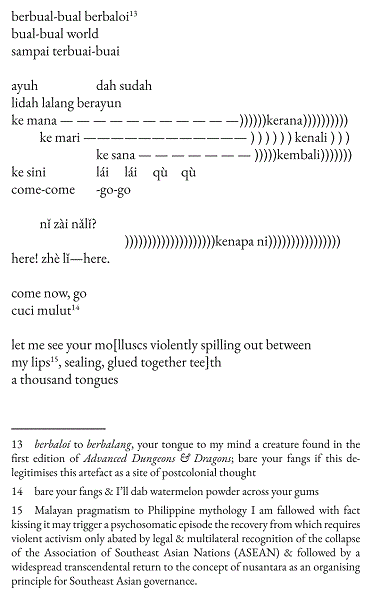
blood/work Listening to bani haykal, David Wong Hsien Ming and Izyanti Asa'ari read their closing poem 'mak tengok' at the launch of their joint work, blood/work felt chimeric and choral: their cadences, languages and intonations blended in portions of the poem that they would read in unison. It felt to me something historic and rare, under the green pallor of the lights at the bar Behind The Green Door. It was a reading that would not be replicated anytime soon, a manifestation of the complexity of the poem's layout on the page. Translated roughly to "mother looks", the three poets read across languages and within the text, alternating between the poem and footnotes, as can be seen below: Malay and Chinese pinyin dart across the page, alongside playful interpolations of punctuation. The interplay between text and footnoted text, in their vastly different references and articulations, nods to Hamid Roslan's work in parsetreeforestfire (2019). The footnotes reflect the varied interests of the poets – Dungeons & Dragons for Wong, Southeast Asian activism and political history for bani, and a juxtaposition of restraint and pleasure in the footnote in between (perhaps Izyanti?). This speaks to the tension at the heart of Afterimage's ALLTHETIME folios. Borrowing its name from a neologism featured in Arthur Yap's poems, 'allthetime', the series' concept is elegant and novel: bringing together poets across generations whose work, though perhaps not complementary at first glance, bear resonances. Their first folio, rib/cage, brought together the work of veteran poet Rosaly Puthucheary, spoken word poet ArunDitha and newly published poet Zeha, with poems interested in womanhood and femininity, the bodily and the sensuous, romantic elation and disintegration, and ethnic marginalisation. bani, Wong and Izyanti, by contrast, are from a similar generation by age (with all of them being born within the same four years), though by publication they are arguably of different generations (bani's debut collection was published in 2007, Wong's in 2015, and blood/work is Izyanti's debut). There is a tighter linkage between the three poets in this second iteration of the folio series, even despite apparent contrasts between the three featured poets. There is a conspicuous difference between Wong being Chinese and Christian, and bani and Izyanti being Malay and Muslim, which is woven into the collection's emphasis on "endurance, immanent pain, and the body's remembering". Grief provides the collection's binding thread in one respect, and the image of blood that provides its other – explained as "kinship, sacrifice, and persistence". The book's cover, designed by Izyanti, captures this tension between tenderness and pain in the form of two hands. The caress of one hand by the other, as nails dig into the flesh of the palm, evoking the affection of joined hands while also providing a shadow of the pierced palms of Christ. Grief, blood, wounding, tenderness and living provide a capacious enough framing for this collection and the conversation it proposes between these three poets. These poems impel confrontation with anger, compassion, mourning and action. Some might find it hard to follow the polyphony of these multiple and overlapping voices, but the collection offers novel ways to read these poets in conversation while offering a timely and sharp political critique. The role of structure and arrangement thus takes on particular importance for the sequence. Many of bani's poems in the collection read as profound manifestos, fusing his experience of rambunctious spoken word and prophetic excoriation of the exploitations of our present moment. Wong's poems circle the deep wounds of personal parental loss, in addition to losses understood vicariously. Izyanti's poems mirror the grief in Wong's poems with their own reflections on loss and distance, strengthened through scenes of domesticity, while complicating the instances where both Wong and bani turn to polemic. Pairings, groupings and pauses do much of the work in this collection, drawing out resonances between forms of anger, frustration and sorrow, in movements between an intimate witness of death and the crying out against forms of mass death that have become normalised at our present point in history. Take the book's opening sequence, for example. Izyanti's 'Parting words' is placed alongside Wong's 'Meeting Your Mother, Meeting You' and 'To Take Care of Your Mother'. The first poem is presented in two voices – a grandmother addressing her granddaughter, and the granddaughter's response. In couplets, the first portion presents a matriarchal wisdom pleading obedience and compliance. In the imperative, she states "Be careful where you go / what your hands reach for", especially "What may be carried into the winds / Lest it be flung back upon your nose". She instructs "Jangan memberontak. / Yang jahanam kita", an injunction against rebellion, or succumbing to a latent wickedness, otherwise "It is you that will be destroyed". The corresponding response from the granddaughter asserts "Let me be the destroyer". Let me "unfurl my tongue, / With my blackened skin, / Nyai let me unfurl my tongue". The granddaughter will "swallow the blood-seed", bring "death to the gates" and "clear the field for you, as you walk". Refusal is in service of a destructiveness that seeks not to embrace wickedness but provide prophetic witness against injustice and forthcoming desolation. The contrast with Wong's poems is stark. 'Meeting Your Mother, Meeting You' is addressed to the speaker's father, "Veins blue and green" like "Chinese foliage drawn against a tall face", the memory of him in "your high school uniform" behind "the black glass of her pupils". It is an explicit meditation on ageing, in which "devotion bubbles into void" amid the "smouldering river of memory". In 'To Take Care of Your Mother', the same is asked by the speaker, the father, of his son, to "Undo the woman before you". It is a trick of reversed time: "pretend your unbirth / and her [unpregnancy]", "the unbloom / of every Bougainvillea / In the family garden". The cadence of the poem builds steadily, imploring the speaker to "unwash the lies and cheap apologies", the attempts to "use barbed words for reconciliation", returning to "meet her in her girlhood". Wong's poems swim in an anticipatory grief, keenly aware of paternal mortality and the proximity of death. They parallel Izyanti's poem in their meditations on intergenerational relationships and the presentation of advice and instruction. Yet for Wong's, the child's voice is absent, buried beneath the pressures of filial responsibility; so too does Izyanti's represent a certain filial responsibility while foreseeing wreckage and possibility. In other instances, the poets' work responds directly to one another, speaking to a more engaged process of interaction rather than through the primacy of an editor. The pairing of bani's 'terhempas' and Izyanti's 'The horizon bends' is a clear example, with the latter referencing the name of the former in its subtitle. bani's poem is written in Malay, with "terhempas" translating roughly to "crash", initially for a dance performance staged at Greymatter by Teater Ekamatra and recorded as a track in bani's album PUTING BELIUNG (2022). Its lines allude to the speaker's feeling of being stuck, adrift and confused, experiencing a powerlessness in attempting personal change. The poem concludes with the speaker's desire to lean on the temporary embrace from the old words of an unnamed counterpart, words that soothe the speaker's sorrow. bani's interest in the Nusantara as a polity returns with force later in the book. Izyanti's response eschews the more rhetorical and abstract in favour of more tactile descriptions: of water tickled with "your toes, / urging the tide in with a lightness", the breeze whispering "through fingers", and the horizon "[squinting]". The passage of time is evoked through images of "soft tidal waves" and "grass growing overlong". The speaker addresses a quiet subject whose hair she caresses, who is asked if she wants to drink water, watch TV or eat something. These images suggest a grandmotherly subject, subtext absent from bani's poem. The breeze "catches your hair" and "[grazes] the quiet pearls that / droop from your ears". There is something of the coastal imagination that persists, linked to Singapore's maritime identity, an inheritance from our archipelagic history and communities. Izyanti's poem seems to ground bani's in a more specific geographical and relational context, away from broader examinations and proclamations of regional identity in favour of the tenderness that comes from accompanying an aging grandparent. Or in a pairing of another sort, the sequence moves to Izyanti's 'Rubik's Mess' and bani's 'internet mess'. While not directly inspired by one another, these two poems are certainly in conversation with one another, albeit through the operative metaphor of the "mess". This suggests a degree of chaos, incoherence, disorganisation. Izyanti takes the metaphor of the "body" as a "Rubik's cube" as the point of departure of 'Rubik's Mess', a frustration with the complexity of the body when the speaker seems to "hurl her against the closest plaster wall". The "puzzle" of the body draws a certain rejection, just as the speaker is "a defiance of demographic, of age race tropicality tumour cell-type". The speaker's body confounds medical expertise, just as medical discourse enters the poem:
To the familiar reader, these are suggestive of a breast cancer identification, prefiguring the excision of "carcinoma". Perhaps the metaphor of the "Rubik's cube" is suggestive of the endless permutations and combinations within the body that lead to the emergence of cancer. It is after the operation that the speaker describes how "multiple planes / unfold" – the body surviving the numerical segmentation that comes with diagnosis and the pain of treatment. Again, Izyanti's poem turns the attention of the reader to the bodily experiences of women through illness and age, a counterpoint to the reflections offered by the other poets. By contrast, bani's poem 'internet mess' speaks to the disembodied mess of digital culture, reflective of his interest in the implications of the Internet's pervasiveness. It is sprawling and repetitive, presented as a prose poem on the page though containing the cadences of a frenetic spoken word performance, replete with repetition. "i'm a mess even without the internet" recurs in different formulations, describing how the internet "destroyed and disrupted ruptured and disfigured incontinence mystified". It is the mess of "the future of sterile jumpscares and funfairs exploding crypts cryogenics combustion", of the chase to "upkeep the cornerstone of legitimate humour our hour is chaos in a nutshell". There is the simultaneous enrapturing by and disgust towards the addictive, frantic nature of Internet immersion. The mess is "31st century architecture", with the speaker reduced to saying "i'm hungry, i'm a monkey", messy "because i'm lazy, automated", facing a "subjective death without clarity". The disembodiment induced by extensive use of the Internet returns the speaker to an awareness of bodily limitation. Nerves fry, in a way, distinct from a cancer diagnosis and treatment. Or consider the pairing of Wong's 'Letters to Bone' and Izyanti's 'Doorway'. 'Letters to Bone', a multi-part poem that is one of the centrepieces of his first collection For the End Comes Reaching (2015), a gutting tribute to the final days of Wong's father. With shades of Paul Celan, Christian Wiman and Philip Larkin, the poem best emblematises, as Christian Yeo has described in his critical introduction to Wong's work for poetry.sg, the questions of "How do we forgive our fathers, especially after they're gone? What does it mean to be fathered? Where does a child's love go, if not into the ether?" It moves, as Yeo describes, from "visceral image families accompanying cancer's slow arresting of the body to cinematographic vignettes warping through the family life of the persona's father." Reading the poem again, 10 years since its publication, shot through with its religious cynicism, its incantatory anaphora, its resignation and release, and its grief, its power remains. What changes how the poem is read is its juxtaposition with Izyanti's poem 'Doorway', which precedes it. Izyanti's speaker addresses a person who "has left", whose "house remains". The speaker is ostensibly a matriarch, describing the experience of being uprooted from her kampung and moving to a flat more cramped and emptier than where they lived before. The poem adopts a more casual, conversational tone incorporating English and Malay:
The image of the bone ("tulang") reemerges in response to an observation of temperature control, how the comforts of fending off the heat with air-conditioning simultaneously cause the bones to ache. The house has been vacated – by the speaker, the speaker's son, the speaker's grandchild. Such absence causes a kind of interior death, with furniture covered in dust. The empty home also speaks to a form of social death, the significance of the new urban flat giving way to a sapping of life, an absence characterised by grief. It speaks to the lives lived by the living in the aftermath of a passing, while Wong's reckons with the excruciating process of bearing witness to dying itself. In other instances, however, there is a particularity to each poet's concerns that makes such groupings difficult. This is perhaps most clear when the poets are defining terms of their political engagement, the stakes of their poetry. By this I mean concerted critique of governments and ideologies. Wong and bani stand out in this regard, not because Izyanti's poems are not outspoken or impassioned ('Underpass' critiques the policing of the Malay community by Malay officers), but by virtue of the former's explicit invocations of specific objects of critique. For Wong, these take the form of newer poems entwined in the braiding of the collection, particularly those that, while still engaging with themes of death and grieving, incorporate sources of anger and grief from South Korea. Wong's personal involvement extends from his marriage to a Korean partner. A poem like 'memento mori as memento mori' bears an ecological imprint, speaking of "children on a boat" who "unload their grief into a stray wave". Ashes are "tucked into seabed / blanketed by foam and yesterday's plastic" before returning as "jetsam refugees" to be "pat down / into sloppy castles" before draping "the course of the coastline". It is not the futility of such scattering, but of the death of rituals of death themselves, succumbing to the passage of deep time in the ecological sense. This finds some parallel in the later poem 'Augury', assuming a biblical narrator's authority, describing how "After securing gold / we made gold our security / and security a golden calf". The poem describes the calf being ground "into power" and imbibed, the children of those who made the calf inheriting only "turmeric", the children trying to boil it "into dye" but "ran out of cloth", tried "making love, but ran out of waves", making "idols of children", seeing "skyscrapers" as "the limit" and receiving "mosquitoes in amber", an "heirloom from another age". The seductions of power and narcissism lead invariably to an overwhelming technological progress that diminishes humanity and the natural environment. Wong focuses concerns over legacy in the poem 'After Dongju'. Yun Dong-ju was a poet active in the 1930s whose lyrical works objected to the brutality of Japanese colonialism, beleaguered by the way the social conditions of linguistic erasure affected his ability to live a conscientious life. There remain numerous monuments and museums dedicated to Yun's life and work in Seoul. Wong's poem takes up many of the images prominent in Yun's work:
Yun's poems were compiled and published posthumously in Sky, Wind, Star, and Poem in 1948, after his death in 1945 while imprisoned for his participation in the Korean independence movement. Wong's poems allude to conditions of entrapment for a speaker who has bade farewell to an unknown "you", perhaps Yun, perhaps someone else of whom the "pines still [talk]". The speaker gazes upon the sky, feeling the passage of time, subject to the rain and the portent of "possibility" falling on the "prefecture". It is easy to read this as an allegory of Korean yearning for liberation from Japanese rule, with the political unit of the "prefecture" having been an administrative imposition on the Korean peninsula. There is some distance from the parallel history of the Japanese occupation in Singapore, though this would be to attempt to read what is not present into Wong's poem. Where this leads is to the poem 'Photo of the MV Sewol sinking' later in the collection, which functions as a protest against one of the greatest avoidable tragedies in contemporary Korean history: the sinking of the MV Sewol ferry in 2014 resulting in over 300 deaths, including 250 students from Danwon High School in Ansan. The ferry's captain famously fled the ship as the ship sank, while then President Park Geun-hye deliberately resisted a more urgent response to the crisis. The sinking remains a scar in the national psyche of South Korea, a symbol of corruption, negligence and lost innocence, contributing to the impeachment of Park. It has also become the source of much political commentary, art and poetry, including in my own life and work. As a student at the time, I was deeply affected as the drowned high schoolers were my age. The anger and grief have stayed with me, realised as a poem titled 'sewol' in my forthcoming collection azalea dialogues, itself considered with the politics of Korea and the Korean diaspora. Wong's is the only poem that is paired with a photograph in the collection. Wong's speaker describes a "thin smile" saying "nothing stays white" and alludes to both Robert Frost and The Outsiders by S.E. Hinton, in which "Ponyboy's gold" is "reasonable in hindsight". There seems to be an allusion to futility, or resignation to the inevitability of nature's might, the "same doom" that befell the ferry. Yet, Wong asserts that "250 didn't get / a couplet", here a reference to the students who died. The second half of the poem shifts its focus to the Park administration. The speaker asks the reader to imagine a "table on its side", flipped by "a salesman" in the "middle step of peekaboo" to "a smiling administrator". The speaker asks the reader to imagine this done again with "the salesman's friends / from the shipping company" and "the intelligent men in the Blue House", referring to the bureaucrats in the presidential administration, and how it is easier to "harbour madness" than "a woman in a bedroom / holding a plume of knowledge". It is easier on the conscience to assume the tragedy to be the result of madness rather than wilful inaction, for blame to be attributed to private interests and incompetence. Amid human-induced destruction and avoidable tragedy, Wong describes in the later poem 'The Brain Train' that
The political necessarily extends from the personal, with ties to Wong's marriage into the world of Korean politics and culture as well as his professional life as an educator working with junior college students. bani's continue in the vein of 'internet mess' – sprawling, dense, incantatory pieces recited with an urgency and tension. 'antimimesis manifesto' and 'colonialism is still breathing' are the starkest, and perhaps more powerful, examples of this, combining the frenetic, talky pace of bani's spoken word approach with the rigour and urgency of his political analysis. To hear bani perform 'antimimesis manifesto' is to be held in rapt attention by the tension and puncture of his expression, as in "canned laughter, cue laughter, you, laugh, wait for it, wait for it, go!". Using sitcom tropes as the poem's conceit, the "go" punctures the show cues that inform television tropes. The poem is part performance, part monologue, part polemic, laying out the proposition that "art imitates life" is "philosophically obsolete", for in "life in the 21st century" the "individual now, like art, is a commodity". The poem sputters along with repetition like "he he he" and "pointless, pointless, pointless". Individual wants and desires, commodified, quantified and regulated, are "planted dreams" are "behavioural futurebrackets" in a "situational-comedy chokehold by the lords of Silicon Valley and every national security agency". The combined forces of tech oligarchy, government overreach and surveillance capitalism come to a head with the range of desire constrained, or dictated, by the awesome inescapability of powers that shape and modify attention and desire. The old adage that being smart is "the elegant survivalism spell" is displaced by "shells with ghosts experiencing information burnout". There is the continuing rush "towards the infinitude of polymodernism", yet the question remains of who "the smartness in our pockets" benefits. The speaker pleads, "manufacture me so i may dream an empire of zombies, post-Fordism snowflakes without context". The poem concludes with the shifting location of laughter, "someone's laughing at us". bani is able to draw a line from the Industrial Revolution to the rise of American corporate giants to the oligarchic power of the tech companies owning artificial intelligence and controlling reams of data to the continuing addictions and subversions of internet culture. bani links this to the continued force of colonialism in 'colonialism is still breathing', first recorded as the track 'refusals' on his album RUPTA BENTUK RANGKA DERHAKA (2025) as a commission for the 2025 Thailand Biennale. This is not a prose poem sprawled on the page but retains a similar intensity to the previous 'manifesto'. bani remarks on manufactured consent and media manipulation as his speaker declares:
Most immediately addressed is the way the media, particularly American media with a global presence, has served to obfuscate the origins of murder and genocidal violence in Gaza while calling into question official death numbers from sources such as the Palestinian Ministry of Health. The naturalisation of mass death and obfuscation of the systematic campaign of violence by the state of Israel is one continuing form of colonialism. Another is the desire for a proximity to power, in the poem's case a proximity to American and European power, "kin who skin graft whiteness to themselves". Here, bani speaks of colonial apologists who "excuse conquest" but "change their story once empire expires". He goes on to critique the notion that colonialism "is still selling the idea of freeing people who they believe are oppressed" by having his speaker assert that freedom "is a trap engineered by colonisers". People are made to believe they are "shackled / by the fictional premises of insufficiencies, / inadequacies and inabilities." The speaker asserts:
bani critiques the co-opted intellectual, or radical, or revolutionary, de-fanged by the contingencies and obligations of a career within the bounds of a political and economic structure. Singapore's history is replete with examples of this co-optation, particularly into political office and the public service (admittedly, I felt a slight pang of recognition through these lines, seeing as my understanding of decolonial theory was developed largely within similar institutions). The seductions of power and wealth this promises are echoed in the later poem 'mungkin kau tak', in which the speaker chastises, "mungkin kau tak / penat jadi barua penjajah", translated to "maybe you are not tired of being a coloniser". Accusations of resource extraction, being possessed by "white supremacy", human values shrouded in "halal terrorism", colonial structures conspiring to protect those who have ascended to a "colonial" class of power. The speaker's call, in 'colonialism is still breathing', therefore, is to assist the "demise" of colonialism:
There is a prophetic undertone to this call to action, weaving violence, resistance and victory. One is invariably reminded of Fanon's call for a violent supplanting of the coloniser, or the surpassing of the coloniser by dint of sweat and labour. bani's poem thunders with a moral charge as the poem ends: "may the flesh of your sins consume / you in death, forever devoured and spat / into ether". Polemical poetry can bear the risk of being too didactic, but bani is able to hold this rhetoric alongside a plethora of vivid images. He writes with a particular authority and clarity that does not make such pronouncements feel unearned. The effect of this can be to make Wong and Izyanti's sharper-edged poems pale in comparison, especially when they are placed one after the other. Though perhaps, in recognition of this, the collection's second section ends with a more meditative set of poems. Izyanti's 'Caldera' features a speaker climbing a volcano, meditating at the mountains. The intensity of physical experience invites greater attention as the speaker sees the flies that "settle on boulders / and lick salt from skin. / Black wings upon my arms". The speaker is "hypnotised" by "stuttering canopy light", spaces creating pauses within the line. The speaker, still, allows flesh to will "itself / into granite", to hold "warmth from sun", to let "moisture into vein". In 'Rituals', Izyanti's speaker bites "into pumpkin seed", tasting "jasmine" instead of "salt, / nut and earth". The poem opens into revelation of a funeral setting, between "white cotton, / crumbled mothball, / jasmine string", "petals bruised and picked apart", "past flesh" that the speaker and their family "rinse, turn, clean, caress", and the deceased sunk "deep into soft soil". And in the closing poem to the section, bani's 'azimat' strikes a more hopeful tone by means of a didactic register:
The collection's closing section foregrounds divinity, titled 'please return back to your maker'. It opens with an interweaving of poems from Wong and bani, starting with Wong's twin cinema 'For the End Comes Reaching'. Lending its name to Wong's first collection, the poem's form mirrors the burst of formal curiosity and experimentation that shaped much of Singapore's Anglophone poetry scene in the 2010s, in large part driven by SingPoWriMo. Between the breaking of words across lines, the imminence of death, and paternal remembrance, the poem is a distillation of many of Wong's concerns circling grief. The juxtaposition with bani's poem afterwards strengthens its emotional force. bani's 'puting beliung', or tornado, poems similarly emerge from grief, both having first been featured in different forms in PUTING BELIUNG. 'puting beliung (1)', written in Malay, addresses a hidden voice, someone with whom the speaker seeks peace and the ability to decorate memories. The traces of the addressed are stuck in the speaker's mind. It concludes "tiada saat yang ku lupakanmu / jangan rampas bayangan dari ku" or roughly, "there is no moment that I forget you don't take away my shadow". The conversation with grief persists throughout the collection, between the approach, arrival, engagement and remembrance of death. Yet the sequence turns its attention from a personal experience of grief to a collective one as both Wong and bani mourn killings from afar. In 'Ghazal for suffering on the television', Wong writes,
And in 'puting beliung (2)', bani writes,
The invocations are not explicit, but it is unmistakable that the ongoing genocide in Gaza, conducted seemingly without restriction by the state of Israel, is central to the moral concern and indignation of both poems. That these are two poems in bani's 'puting beliung' sequence suggests the entwining of a personal and collective grief, a throughline between a grief observed intimately and from afar. Tears are the motif that recur through Wong's ghazal, seemingly until no more tears can be shed. bani looks not merely to the site of suffering, but the scuppered aspirations of a community induced by hypocrisy, commercial interests and the cowardice of those who would look away. The second half of bani's poem takes aim at the Singapore state, denouncing "wayang galleries using / your names as propaganda", "glorifying / unbridled kindness they've bestowed / elevating themselves by acing / PR yet failing to acknowledge your / humanity". The replication of dehumanising language through the passive voice in The Straits Times when describing the killings of Palestinians, the self-congratulatory nature of aid and scholarships, and the refusal to take more dramatic action against the state of Israel are all part of bani's critique. Injustice and suffering must necessarily stir grief and compassion and anger, as seen in Wong's poem, and must be translated into material action. The failure to do this animates bani's poem. Amid this concatenation of griefs, Izyanti's ekphrastic poem 'St Sebastian' introduces a momentary meditation away from the urgency of present events. It is written after Berlinde de Bruyckere's Cripplewood (2012), an installation of a large, fallen Burgundy elm cast in wax, epoxy and textiles. It is presented as a wounded body, gnarled, bringing to mind suffering and healing. De Bruyckere's reference to Saint Sebastian alludes to his martyrdom while tied to a tree, shot with arrows, as well as his recurrence throughout Venetian art. Izyanti's speaker beholds the piece, transfixed, recognising the "held breath of in-between" death and life. The speaker addresses "Sebastian who is Narcissus, / saint of all else falls away, / here I lie entranced, entrenched". One thinks of the homoeroticism of the scene, Sebastian rendered experiencing pleasure amidst this violence. The speaker describes the installation: "limbs of branch and bone / cling across stripped elm, / waxen torso, corded with linen of sleet gray, olive / blood rust and opal milk". The "sublime in-between" is the threshold between life and death; the speaker knows that Sebastian knows this for "what other ecstasy would animate wax / to arch your back towards skylight?" The fallen elm is "not alive, / only cold clammy and captivated". The speaker is brought to a wordlessness as she gazes upon the piece: "what then can we call this?" The shift to the section's final poem is jarring. It is bani's final manifesto for the collection, titled 'nusantara pessimism / a not so mani(s)festo', riffing on the word "manis", Malay for "sweet". The poem proceeds from bani's interest in futurity, in technology, in the social implications of rapid digitalisation. The speaker declares that the "Future / is an endless regurgitation of / the same oppression", as well as "violence" that we see today. It is "security, prosperity / and hegemony" that powers this breakneck procession. The notion that the Future "revolves around / the romantic idea of dreaming" implies that we are "sleepwalking / snoring through the horrors of the present". It is to "defer attention from / what's before us right now". The present is "utopian for the 1% / and dystopian for the rest of us". An obsession with the as-yet realised is what enables complacency, or wilful ignorance, towards the present. The speaker's declaration is the need for "a new paradigm that helps / us re-orientate our strategies", and it is "pessimism". The speaker declares that the Malay language has no word for future, and that wealthy and political elites "berdakwah" or "preach" to dream "for the sort of joys we don't encounter today". In bani's crosshairs are "bureaucrats" who plunder, "privileged poets who cosplay / as curators" and "portfolios, / CVs and inflated egos of authority". "sila pulang ke rahmatullah", he declares, or "please return to your maker". The closest approximation of the "Future" in Malay is "masa depan", which the speaker describes as "time ahead", or "the time we will be facing", bearing the implication of inevitability. There is only "lusa", the word for the day after tomorrow. bani's speaker bemoans "a future already / built for the privileged", featuring "freeports", "money laundering", "decentralisation" and "a cesspool of financialisation". "Nusantara Pessimism", therefore, refers to the "prolonged, extended horror / of the present", with any optimism only persisting to "what comes after today". Pessimism allows "living & unraveling in the extended / and untimed present" and ways "to dismantle what we would potentially face". The speaker asks, "how do we refuse / and ensure noncompliance / nonparticipation / doesn't further marginalise?" The future, just like freedom, is a "spell casted into existence", is a "fiction for colonisers, elites" who "plot out / the biggest scam in the history of humanity", is "a construct for submission". bani weaves many of his critiques throughout the collection into this poem, articulating a set of principles and responses to our present crises with no promise of resolution. The collection concludes with 'mak tengok', or 'mother sees', an explicit attempt at weaving the voices of the three poets, incorporating the predilections, interests, concerns, approaches and techniques of bani, Wong and Izyanti. It features multilingualism, footnotes, words scattered across a page and the motif of the snake. The poem concludes,
This is a collection that does not seek to coddle a reader, but to bring a reader into the unsparing necessities of grief, anger, compassion and action. Where the collection is at its strongest is when the poems of the three poets are arranged in such a way to strengthen, enrich and complement each other's common afflictions. This is no mean feat for three poets of such different backgrounds and who bear such different approaches. However, I was left wanting to hear more of Wong's current voice through more recent work, rather than the surfeit of poems from his first collection incorporated into this new folio. While many of bani's works were featured in his musical and performance projects, their rendering on the page offers a new way of engaging with his cadences and thought. In her introduction, Diana Rahim writes that "when the veils fall, and reality reveals itself, it is not a tragedy, but a reckoning that collapses a future that was never real". This eschatological outcome is what can make the collection read as prophetic, uniting the personal and collective pains and groans that our present polycrises have induced. In a Singapore where poetry has often felt hollowed of substantive political critique, blood/work is a timely intervention, reinvigorating written poetry with a political charge necessary in our era of the wanton embrace of AI, the bloodlust of warmongers and the seeming delight of the powerful in continuing to deprive the dispossessed. QLRS Vol. 25 No. 3 Jul 2026_____
|
|
|||||||||||||
|
|
|
|
|
|
|
|
|
||||||
|
||||||||||||||
|
|
|||||||||||||
|
||||||||||||||


Copyright © 2001-2026 The Authors
Privacy Policy | Terms of Use |
E-mail