 |
||||||||||||||
 |
 |
|||||||||||||
|
||||||||||||||
|
What They Call Me By
By He Jia Wen
A name contains a world of meanings: dictionary denotations, familial wishes, societal influence, lineage, a claim to familiarity. It is a visual representation, but also a sound people call you by. This is my name in Chinese script, Hanyu Pinyin and International Phonetic Alphabet: Hé Jiā Wén /xɤ̌/ /t͡ɕi̯ä⁵⁵/ /wən³⁵/ My surname is He 何. The original script depicts a man carrying an axe over his shoulders; the modern script also carries the meaning of a person shouldering a burden.  Evolution of my surname, in script Credit: Dong Chinese My given name is made up of two characters, Jia 嘉 and Wen 雯. 嘉 describes someone or something praiseworthy, and can variously mean excellent, auspicious, or joyful. 雯describes beautifully-patterned clouds and symbolises brilliance and elegance. Origins My parents named me through a process of elimination, with sound as the basis for selection. The following exchange is a conversation, translated from Chinese.
Product of a Policy People often ask why my statutory surname differs from my father's. I attribute it to national will and parental obedience. In 1979, then Prime Minister Lee Kuan Yew launched the Speak Mandarin Campaign to foster cohesion between the Chinese dialect groups, through promoting Mandarin as a common language. Part of the campaign was to unify Chinese names using pinyin, and dilute the linguistic differences between dialect groups. The norm then was to register names as romanised versions of dialect pronunciations, so the government encouraged parents to register their babies' names in full pinyin instead (The Straits Times, 1979). For example, a Hokkien name 'Tan Ah Teck' might appear in pinyin as 'Chen Yade'. Mum was laissez faire about the business and left the decision to dad. Dad, ever the law-abiding citizen, registered my name in full pinyin, He Jia Wen. No dialect name. This small act severed me from my Hakka forebears (at least on paper), whose surname was pronounced and romanised as 'Ho'. At the same time, the pinyin policy was unfolding in schools. Unlike the registration of baby names, this policy was strictly enforced. In school, Chinese students would only be identified and called by their pinyin names. Every pre-primary and Primary One Chinese student enrolling in 1981 was given full pinyin names, even if they had English or dialect statutory names. The new names would be bestowed by Chinese teachers who had been recently trained on pinyin. Understandably, this policy created confusion for Chinese families and students, many of whom spoke dialect at home. A 1986 article in The Straits Times reported this sad anecdote:
The pinyin policy continued to cause inconvenience in schools throughout the 1980s. Outside of school, parents generally ignored the call for full pinyin name registration: in 1982, the year after the recommendation, only 18% of babies were registered in full pinyin names; by 1990, the proportion fell to 7.5% (The Straits Times, 23 December 1991). Finally, in 1991, the Education Ministry scrapped the policy and the use of dialect names in schools was allowed again. But this was all moot. Because here I was, with my full pinyin name. I became part of a dwindling cohort of Singaporean Chinese with no dialect name, planting the seed of name-related perplexities that would later grow. Call Me Michelle When I was twelve and my brother, ten, my aunt who emigrated to Canada years ago came to visit us in Singapore. The occasion of her visit was to introduce her new husband to the family. My brother and I hadn't seen my aunt since we were toddlers. We were excited by the prospect of an ang moh uncle, and in his honour decided to give ourselves English names. We conferred conspiratorially in the study, pondering the very few English names we knew. By the end of the afternoon, we emerged and declared to our parents we were Michael and Michelle. I found out years later that the names mean 'like God'. That day, however, godliness was not on our minds. The fact was that my brother was besotted with Michael Jackson's album, Dangerous, and favoured the name Michael. And as the female equivalent (Michelle) sounded reasonably nice, we settled on these names. At least, that was what I remembered. My brother has a completely different memory. He said our English names originated from a car ride. According to him, we were with our cousins in the backseat of my father's grey Mitsubishi, driving home after an outing to East Coast Park. It was during the long ride that everyone ended up with English names–Melvin, Adrian, Michelle and Michael. My brother insisted it was our older cousins who gave us our names. I am sceptical: this story has no place in my mind. But because his memory trumped mine in detail, I called up Melvin to check. 'No lah,' he said. 'We definitely didn't name you. You were the ones who told us your English names.' When I relayed this to my brother, he vehemently defended his account. Meanwhile, I remained convinced of my own. But who was I to declare my memory as more legitimate? Memory is tricky, and our stories are fabulations. So despite our contradictory accounts, I thought about the focal point of our fabulations of becoming Michael and Michelle. The focal point of the stories is family closeness. And the fact that we agreed to matching names is a mark of sibling togetherness. Say That Again? UK, 2005. It is the first day of my Masters programme, my first time studying overseas. I am in the seminar room with twenty or so students, all looking around with shy, friendly faces. The course coordinator is checking off the register. I listen for my name, ready to join the others in declaring 'Here' and begin my adventure. 'Jai,' the coordinator calls. No response. 'Jai?' She repeats, uncertainty creeping into her voice. 'Jai Hee?' People look around. Seeing no response, the coordinator moves on. The moment she closes the register and my name hasn't been called, I realise: Of course–Jai Hee is me.
Calling a name is a relational act: it is uttered to get your attention, to seek a response. So what happens if the call is not recognised? I had been aware of my unpronounceable Chinese name since junior college. Then, I was in the Humanities Scholarship Programme which was largely staffed by British tutors. Through them, my name sounded exotic. 'Jia' was an especial stumbling block–I did not have to be a linguist to know the pinyin 'ji'-sound was not made for British tongues. Mr Harry made me repeat it slowly, multiple times, and even put his ear close to listen before throwing up his arms in defeat. They also often misspelt my name on school documents. As a 17-year-old enchanted and intimidated by her foreign teachers, I did not press the point. I was clearly not the first student in this situation. When the school pinyin policy kicked off in 1981, the Education Ministry said it will 'go easy on expats' and they 'need not fret and twist their tongues'; the Ministry 'will be satisfied if teachers can pronounce names correctly–even if they use the wrong tones' (The Straits Times, 21 May 1981). The Ministry also helpfully suggested that teachers could organise name-reading sessions among themselves with the Chinese language teachers as guides (The Straits Times, 6 March 1981). I wondered if these sessions ever happened, and how long they lasted. I tried to imagine my tutors sitting in a circle, practising our pinyin names. Mr Perry would cooperate fully and try his best. Mr Burge might take an intellectual interest in the pinyin system. Mr Harry would be chortling throughout in his signature guffaw. Mr White would most certainly be absent. And the poor Chinese teacher, tasked to tame unruly pronunciations, would be wringing her hands in despair.
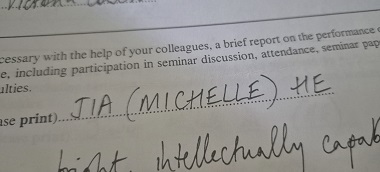
With my junior college experience and the Jai Hee incident, I decided to activate Michelle in class. After all, I was in the UK and studying English Literature. An English name would oil the engines and make me more memorable, perhaps even more credible, to my instructors. But I never fully identified as Michelle. Despite using it in all social occasions, having two names diluted me. My instructors called me Michelle in class, but wrote my official name as 'Jia' in exam reports. They had mistakenly thought that 'Wen' was my middle name, and often elided it. I never corrected them.
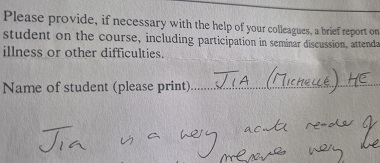 In the years that followed, I studied at a US university and an Australian university. Both times, I introduced myself as Jia Wen. Both times, very few instructors mastered the pronunciation. I could tell when they hesitated to call on me as they did not want to mangle my name. But I determined that Michelle would not make an appearance. I no longer wanted a name of convenience while my 'real' name remained in the shadows. Michelle has since become a utility name. I use it at Starbucks, for online subscriptions, over the phone with customer service. I use it when a name was required but not essential, to smoothen the transaction. The irony: Michelle was the only name I gave myself, but I am least attached to it. It is a name I use with someone I do not expect to build a relationship with. A Gift from Friends Chao, one of my best friends from primary school, sends me a video. I click it open and see her two-year-old girl, looking bashfully at the camera. Offscreen, I hear Chao prompting her: 'What do you have to say to Auntie Boon Boon?' After a moment of hesitation, the toddler blubbers dramatically, 'Thank you Auntie Boon Boon!' Three decades ago, we met in primary school as Minchao, Huihui, Yiru and Jiawen. Then, we bonded as Chao, Hui, Ru and Boon. Among the four of us, I was the odd one out with the nickname Boon, christened by my friends when we were ten. Recently, I asked them how they came up with this nickname. According to them, our fellow classmate Zhi Wen's name was spelt Jyh Boon, and since his and my names share the Wen character, they decided to call me Boon. Was it that Wen sounded too formal, or was too hard to call? Were they staking claim to familiarity by calling me Boon? They could not recall. But I got a dialect name after all, no matter that Boon was Hokkien, and I was Hakka. Over the years, my friends plumbed the emotional breadth and depth of Boon. It could be uttered as a light-hearted Boon, a playful Boon Boon, or wailed out in despair, with the elongated 'oo' and the trailing 'n'. Ms Ho, Ms He and Dr He My pinyin surname became an issue when I started my teaching career. I had to verbally introduce myself to students so that they knew how to address me. Initially, I decided I shall be Ms Ho (2007-2010). I reasoned this was how my surname was meant to be spelt, and here was a chance to right a wrong. Moreover, I felt Ms Ho was more visually appealing on paper than Ms He. But most importantly, I liked its ring when it was called. The inconveniences began almost instantly. My name was spelt 'He Jia Wen' on the school staff register, and colleagues knew me as Jia Wen. They did not know I introduced myself to students as Ms Ho, and were confused whenever students referred to me. Two years later, after people began to register me as 'Ms Ho', the school welcomed the arrival of a new teacher, Ms Ho Jia Yun. Now, people were mistaking one for the other, and were sending emails to the wrong person. Some thought we were sisters, others thought I switched my teaching subjects. Finally, I decided to end the confusion and bow out as Ms Ho. Afterall, I was just the wannabe, not the real deal. The following year, I introduced myself as 'Ms He' (2011-2019) to my new students. Later, they admitted that when I first introduced myself with a pinyin surname, they wondered 'Is she from the PRC?' followed by 'And she is teaching us English Literature?' They were fascinated that someone from China was going to teach them the subject. As I had suspected it would, 'Ms He' was replete with auditory ambiguity and awkwardness. Two eye-rolling jokes from students: 'Ms He ('her')? But we don't miss her hahaha!' 'Ms He ('hee')? Is that a man or a woman hahaha!' I would not claim that this motivated my pursuit of a doctorate, but after nine years of being Ms He, it was a pleasant surprise to introduce myself as Dr He (2020-present). I joked that I had finally graduated from a gendered honorific, but I was more delighted to discover that 'Dr He' was easy to roll off the tongue. Today, former students variously call me Ms Ho, Ms He or Dr He. The way they address me marks the era of my teaching career, my progress from beginner teacher to an experienced one. Call and Response If the relation between signifier and signified is arbitrary, as with Saussure, how do I figure out who I am through the many signifiers I am known by? I know I am not the sum of my names: they might represent me, but the creation, use, misuse or disuse of one or more would not diminish me. Deleuze and Guattari's rhizome could be a possible representation. Instead of a tree-like structure mapping my roots and my past in a linear and static way, all these names are non-linear and dynamic, a rhizome that:
I think of my names growing, flourishing, and withering around, through, on, and next to my experiences. The names I have had grown from history, affection, necessity; they will continue to change, and new ones would no doubt emerge. By a twist of fate, my British tutors from junior college became my colleagues, seventeen years after I met them as their student. Over the years we taught together, I would grow comfortable calling them by their first names–they insisted that I must, and would not respond if I started with 'Mr….'. They never quite mastered the pronunciation of Jia Wen, but no matter. In all other ways they welcomed me to the fold and treated me as their own. Working alongside them were the best years of my career. I think about how Michelle never achieved the same flavour as Boon. Or how students' jibes on my surname were playful, not malicious. And how my tutors' slips didn't jar as much because I understood their care. Perhaps it came down to who does the calling, and how the name is called. If I listen intently to the calls by people I care about, they capture for me the sounds of love. QLRS Vol. 25 No. 4 Oct 2026_____
|
|
|||||||||||||
|
|
|
|
|
|
|
|
|
||||||
|
||||||||||||||
|
|
|||||||||||||
|
||||||||||||||


 Credit: He Jia Wen
Copyright © 2001-2026 The Authors
Privacy Policy | Terms of Use |
E-mail